Physiotherapeutic Rehabilitation of Knee Arthroplasty
THE FOLLOWING INSTRUCTIONS ARE WRITTEN BY MY PHYSIOTHERAPISTS: MARIA ANDRIOPOULOU AND DIMITRIS YAMA WHOM I THANK.
The physiotherapist
; assess the condition of your respiratory and muscular system preoperatively;
teach you the exercises to increase muscle strength and knee mobility;
teach you how to move from/to bed and chair;
teach you how to walk with an
aid; teach you how to climb / descent on a scale
; show you the aids you will need postoperatively;
· He will teach you how to dress, how to move to the toilet and shower;
and finally he will show you any changes in your space, making your life easier postoperatively.
Preoperative evaluation
As part of the preoperative evaluation, the physiotherapist will teach you and your family the exercises you will perform both before and after the operation. Because of many months, even years of pain and reduced physical activity, your muscles and respiratory system are probably not in the best condition. By performing the right exercise program for you, it will facilitate your movements postoperatively and reduce the risk of complications from your respiratory system. Also, the physiotherapist will choose the ideal walking aid for you (walker or elbow bacteria) and teach you how to walk and go up and down stairs.
During his home visit, if necessary, the physiotherapist will examine your home environment and indicate any changes that will make it easier for you, such as choosing a comfortable chair for you, removing carpets, cables, pets, placing everyday objects at waist height, etc. In addition, he will recommend the aids you will need, such as the toilet lift, special auxiliary bathtub and wall safety handles, sponge with long handle, orthopedic socks, etc.
Postoperative rehabilitation
An important part of your full recovery is an understandable physiotherapy exercise program. Physiotherapy begins immediately after surgery and continues on a daily basis until you are discharged from the hospital. The exercise program is maintained even after your exit, while after the consideration of your doctor and physiotherapist, the presence of the physiotherapist at home may be necessary.
The first session includes simple exercises done in bed, sitting on the edge of the bed, as well as walking, if your general condition allows it. In the coming days, our goal is to regain muscle control of the lower limb, in order to improve the way the exercises are done, sitting in the chair, walking and ascending/descending the stairs. Your immediate mobilization is always encouraged, for your faster independence, but also for the optimal functioning of all body systems (venous, respiratory, gastrointestinal).
From the first day you are allowed to use your leg normally, throwing all your weight into walking, with the use of bacteria or a walker, unless otherwise ordered by your doctor. Initially, pain and fear may inhibit normal gait, but with the help of your physical therapist and doctor, it will soon be restored. Usually, the use of the walker or the two bacteria lasts for the first 2 weeks after surgery, followed by the use of one bacterium for about another 2 weeks. The total duration of use of aids can be either shorter or longer, depending on your capabilities and physical condition, without this determining the outcome of the operation.
Before the operation, it is very common to detect shortening of the hamstring muscles, which leads to the disruption of the gait pattern. The foot learns to step first with the toes and then with the heel, a model inverse of normal. But your body has adapted to this change, and despite knee recovery, it may take a few days for the knee to fully stretch and restore the normal pattern. That is why the physiotherapist focuses his attention on the rapid recovery of the knee extension. This is achieved by mobilizing the patella to avoid adhesions and relaxation – stretching of the posterior muscles and follicular elements.
When you leave the hospital, the bend of the knee should be at 90°, while gradually by 6 weeks you will have reached 130°. These values also depend on the previous condition of the knee (if it had a large limitation in flexion before the operation, the angle will take a long time to restore).
Exercises
These exercises are performed both in the preoperative and postoperative stages. It is recommended that the exercise program be done 2-3 times a day. These exercises may be painful at first, but remember that they will speed up your recovery and minimize pain. If you are unable to perform these exercises because of the pain, do not continue them.
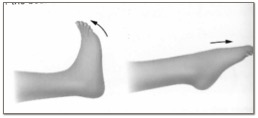
Muscle pump exercise: move the ankle and toes up and down. This exercise helps blood circulation and decongest swelling in the calf. In combination with the use of orthopedic stockings and anticoagulant medication, it reduces the likelihood of thrombosis. Repeat 100 times a day.
Isometric quadriceps exercise: lying on your back with your legs stretched and a towel roll under the knee of the operated knee, press the towel down with the knee, tightening the thigh muscle. This exercise will help you to significantly reduce knee swelling. Keep counting to 5 and relax. Repeat 100 times a day.
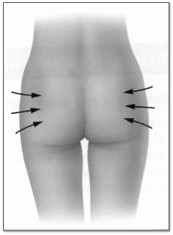
Isometric gluteal exercise: ξ lying on your back, sitting or standing, tighten the muscles of the buttocks. Keep counting to 5 and relax. Repeat 100 times a day.
 Passive knee extension: lying on your back you place a roll of towel under the heel so that your knee is in the air, forming a bridge. You can strengthen the stretch by lightly pressing your knee down. This stretch can be painful if the hamstrings of the thigh are shortened, but day by day your knee will stretch and the stretch will be painless. Maintain this position as much as possible during your bedtime.
Triple flexion exercise: lying on your back, slowly bend the operated leg by sliding the heel on the bed and bring it back. The hip angle should not exceed 900. Repeat 3 sets of 10 reps.
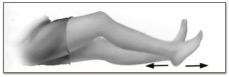
Assisted knee flexion: Lying on your back, place a folded towel on the front of the ankle of the operated knee. Bend your knee as much as you can and then apply gentle pressure through the towel to increase the flexion of the knee by pulling it. Stay in this position for 5 seconds. Repeat 3 sets of 10 reps
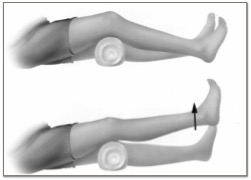 Short knee extension: lying on your back and with a pillow under the knee of the operated leg, stretch the knee. Do not lift the knee from the pillow. Repeat 3 sets of 10 reps.
Hip abduction and adduction: lying on the bed and with the legs extended, you open the hip outward and return to the starting position. Repeat 3 sets of 10 reps.
Knee extension: sitting on the bed or chair with the leg hanging down, stretch the knee. Do not lift the knee or thigh from the bed. Repeat 3 sets of 10 reps.
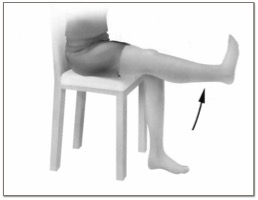
Passive knee flexion: sitting on the bed or chair, place the unoperated on top of the operated and with gentle manipulations try to close it by pushing it back. It is suggested that this position where you perform the stretch is stable every day, so that you can monitor its progress yourself. Repeat 3 times of 30”.
Lifting a stretched leg: lying on the bed, with the knee of the non-operated leg bent so that the sole rests on the bed, tighten the knee of the operated leg and lift the whole leg stretched up. Repeat 3 sets of 10 reps.
Pelvic lift: lying on the bed, bend both knees so that the soles rest on the bed, and raise your pelvis high, squeezing the buttocks. You can help your body by pressing your elbows against the bed. Repeat 3 sets of 10 reps.
Push-up on the chair: sitting in a chair with your hands, detach your buttocks from the chair using your hands (i.e. stretching your elbows). Start with a little help by pushing lightly with your feet, while gradually all the weight is taken by your hands.
Knee flexion from a standing position: In an upright position with the help of a walker, a bench press or bacteria, you raise your thigh and bend your knee as much as you can. Hold it in this position for 5”-10”. Then stretch your knee, touching the ground first with your heel.
At home, continue the above exercises gradually with greater frequency and resistance. Add balance and proprioception exercises (such as monopedal support, toe-toe, heel walking, etc.), as well as a stationary bike.
Stationary Bike: Progressively you are allowed to start exercising on a stationary bike initially without resistance. You can start by performing small semicircles with the operated limb down. Slowly bring the pedal upwards, assisted by the non-operated knee, so that the operated knee flexes. Gradually erase a full circle. Make sure that the amount of traffic, as well as the amount of time you spend on the bike, starts at a low level and increases slowly. Monitor pain and swelling closely and relax if you notice an increase in them.
Always after the exercises and whenever you are in pain, place a cold pad (ice cubes in a bag, ice pack) for 10′-15′.
Breathing exercises
After receiving anesthesia, it is very important to perform breathing exercises. In addition to calm and deep breathing, you will perform exercises with the help of a small plastic breathing exerciser, which allows you to track progress.
Discharge from the hospital
Most
patients are able to return home using a conventional car. The exact instructions are given below. If the route is long, it is a good idea to perform the muscle pump exercises while you are sitting and every 2 hours make sure to take a break in your journey, walking and changing position for a while.
By ambulance
Transportation by ambulance is necessary in case of difficulty accessing the house, such as for example a long uphill/downhill or many steps (depending on the patient’s physical condition).
If
you need to travel by plane, it is important to arrange for your position to be in the first seat, on the treadmill or at the emergency exit, so that you can keep your leg free. Muscle pump exercises are recommended to prevent thrombosis.
Daily activities
Do
not be afraid to put your weight on the operated foot, unless otherwise instructed by your doctor. Stand with your back straight and start walking with the walker or bacteria with an equal stride length, bringing your heel and then your toes into contact with the ground. Your step should not exceed the aid you are using. Do not lean over the aid. correct order is as follows:
Forward movement
; Walker or bacteria
; Operated leg
; Unoperated leg
Reverse
; Unoperated leg
; Operated leg
; Walker or bacteria
Progressively use the one bacterium by holding it from the non-operated side. You start with the bacterium, followed by the operated and then the unoperated one.
Don’t forget that walking is the most ideal exercise for the surgery you have had. There is no specific walking protocol. Start with frequent and short walks, which you will increase as your endurance improves. It is very important not to exceed your limits. If you notice increased sensitivity, pain or swelling in the knee area, reduce your activity, place ice and lie down with your foot on a pillow. If the pain persists, contact your doctor.
Commuting in bed
Getting off the bed
Bend the unoperated leg and lift your pelvis to bring your body to the edge of the bed. Move your body to the other side and lower your unoperated leg under the bed. Push the mattress with your hands and push your body up by bringing your operated leg under the bed. Use your hands to bring your legs straight.
Sitting
on the edge of the bed. Place your hands behind the pelvis and pull your body in. Slowly tilt your body back, bringing the operated leg onto the bed. Bring the unoperated one onto the bed and help your body get into the correct position. If you can’t put your foot on the bed, You help it with the unoperated one.
Sleep
You can sleep in any position you prefer. It is recommended that in the first few days you choose the side position with the operated leg on top and with a pillow between your legs.
 When
When
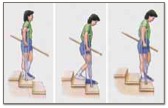
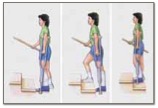
you climb the steps, always remember that the unoperated leg goes first. When you go down, put the operated foot first. Always keep the handrail on one side and the bacteria on the other.
When
you are sitting on the chair, on the bed or on the toilet, approach the rim of the chair so that you can rest it with the back of your legs. Place your hands on the arms of the armchair, support yourself and sit leaving your body slowly, with your operated leg stretched so as not to feel discomfort. Stand up in reverse. It is recommended to change position every 30 minutes after walking. in order to prevent swelling in the legs. In the toilet, use the toilet seat if there is a problem with the bending of the knee and the toilet is too low.
In
the car you sit in the passenger seat. The seat is pulled back as far back as possible to leave you plenty of legroom. Approach the seat with the bacteria or the walker and sit leaving your legs out. Pull back a little further and bring both your legs in at the same time. Exit using the reverse procedure. You are not allowed to drive until the 4th week. So your doctor will tell you exactly when you are able.
When
dressing, it is easier to wear the garment first from the operated side. Undress the other way around, taking off your garment from the non-operated side first.
Bathing
is allowed after cutting the sutures 15-20 days postoperatively. Ideally, the use of a shower is ideal. After 6 weeks and if you have a good balance with the help of a special handle, enter the bathtub.
Pool or sea
Exercises in the water are the ideal form of exercise and are usually allowed after 4 weeks. Start with exercises that will initially last 10 minutes – 15 minutes, after consultation with your physiotherapist.
What is prohibited in total knee
arthroplasty? Do not place a pillow under your knee and generally do not keep your knee in a flexion position for a long time when you are in bed.
Do not drive without your doctor’s permission.
Do not risk walking on slippery surfaces (snow, ice) or on obstacle courses (uneven terrain, small furniture, carpets, pets, babies).
Do not increase the number of exercises without the consent of the physiotherapist and do not continue the exercise when symptoms of pain, severe fatigue and swelling appear. Remember that normally fatigue and pain after exercise should last around 1 hour. Nocturnal discomfort or longer-lasting discomfort indicates severe fatigue.
· Do not switch from the walker or the 2 bacteria to the use of a bacterium if you do not have the necessary strength and balance.
To get the maximum possible results from a knee arthroplasty, you need to realize that total knee replacement is a substitute for the joint, and it is not entirely a normal knee. That is why it may not be able to withstand very intense sports activities, such as a normal joint.

 Hip Osteoarthritis

 +30 210 7292002
 alilikakis@yahoo.com