Knee arthroscopy
What is defined as knee arthroscopy?
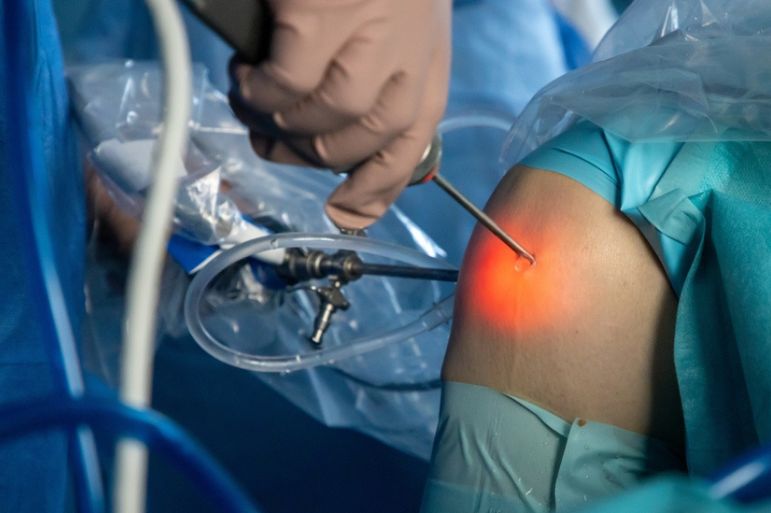
Knee arthroscopy is a minimally invasive surgical technique that allows direct inspection of the joint without the need for extensive incision in the skin and underlying tissues.
During the operation, a thin endoscopic tool, the arthroscope, is inserted into the joint. The arthroscope has a high-definition camera at its end, lighting and connection with a saline supply. The joint is filled with serum and all actions are carried out with the joint in dilation. The camera transmits real-time images to a screen, allowing the surgeon to accurately guide specialized microtools for diagnosing and simultaneously treating intra-articular lesions.
The small incisions required for the insertion of the arthroscope and instruments significantly reduce surgical trauma. In addition, they minimize postoperative pain and joint stiffness and contribute to faster recovery and return of the patient to daily activities compared to open techniques.
In which cases is knee arthroscopy indicated?
Knee arthroscopy is indicated for a wide range of conditions that cause pain, stiffness or functional instability in the knee. When conservative treatment proves insufficient, arthroscopy is the only way to diagnose and treat diseases.
Specifically, it applies to:
- Meniscus tearsthat are a common injury, especially in athletes. The rupture causes pain, stiffness, and difficulty moving. Through knee arthroscopy, suturing or partial meniscectomy can be performed.
- Damage to the articular cartilage that occurs after injury or due to its degeneration. Cartilage lesions disrupt the movement of the knee, causing pain and progressive wear.
- Anterior or posterior cruciate ligament ruptures that cause a feeling of instability, especially during sudden changes of direction. These ligaments stabilize the knee and are most often, but not exclusively, injured during sports. Arthroscopic surgery allows them to be reconstructed using a graft.
- Diseases of the synovial membrane, such as synovitis or synovial hyperplasia, which cause pain and hydroarthrosis.
- Free particles within the joint, such as fragments of cartilage or bone from injuries or osteochondritis. Knee arthroscopy allows them to be removed safely.
- Early knee osteoarthritis, where the joint is cleaned and rejuvenated with the benefit of temporary relief of symptoms, but without being the definitive treatment of the problem.
The choice of arthroscopy is made based on the nature of the lesion, but also on the general condition of the patient and the response to previous treatments.
How is knee arthroscopy surgery performed?
Knee arthroscopy is performed in a surgical setting under regional or general anesthesia, with the patient in a supine position. The lower limb is cleaned with an antiseptic and stabilized with the help of a special device.
This is followed by the creation of a small incision through which the arthroscope is inserted, which transmits a high-definition image to a monitor and provides the surgeon with the possibility of both diagnostic review and therapeutic intervention.
If required, additional small incisions are created for the entry of specialized microtools, through which the required surgical procedure is performed.
After the operation is completed, the incisions are closed with sutures and the joint is bandaged with a sterile bandage. The procedure is usually short and allows the patient to be discharged on the same day as part of a rapid recovery protocol.
Postoperative course of the patient after knee arthroscopy
Recovery and the duration of rehabilitation depend on the type of intervention (e.g. meniscectomy, meniscus suture, etc.).
In the first 48 hours, rest, leg lift and local application of ice are indicated to reduce swelling and pain. The loading of the strand with bacteria is adjusted according to the type of operation and the patient’s pain.
Medication includes analgesics and anti-inflammatories, while anticoagulant prophylaxis is administered in selected cases.
At the same time, physiotherapy begins immediately with mobilization exercises, to prevent knee stiffness and strengthen the muscular system. Thus, full functional recovery is achieved within 6–12 weeks, depending on the case.
A return to sedentary work is possible within the first postoperative week. On the contrary, the resumption of sports activities takes place gradually, based on the restoration of muscle function and depending on the problem encountered.
Adherence to the rehabilitation protocol is a decisive factor for a good outcome and avoiding complications.
Knee Arthroscopy & Advantages
Knee arthroscopy is one of the most common minimally invasive techniques in Orthopedic Surgery. It allows for detailed imaging and simultaneous therapeutic intervention within the joint, with minimal disruption of adjacent tissues.
More specifically, the advantages that characterize it are the following:
- Minimization of surgical trauma.
- Excellent aesthetic results.
- Significant reduction in postoperative pain.
- Reduction of the risk of infections due to the entry of surgical instruments through small incisions and the continuous flushing of the joint.
- Shortening of hospitalization time, as the patient can return home the same day.
- Acceleration of the patient’s functional rehabilitation and reintegration into daily activities.
- High definition and detailed visualization of intra-articular structures in real time.
- Possibility of immediate therapeutic intervention within the same surgical session.
Complications
Knee arthroscopy is generally a safe procedure, however, as in any surgical procedure, there is a possibility of complications, even if they are rare.
The most common include:
- Infection (septic arthritis): It occurs in less than 0.1% of cases and requires early treatment.
- Hemorrhage: A pool of blood within the joint that can cause pain and swelling.
- Thrombosis of the lower limb veins: Although very rare, it may occur in patients with predisposing factors.
- Knee stiffness: It is mainly due to delayed mobilization and requires physical therapy.
- Neurological disorders: Transient numbness or dysesthesia from peripheral nerve irritation near the entry points of the instruments.
The prevention and early treatment of these complications depend on the correct preoperative evaluation, the technical competence of the surgeon and the adherence to the postoperative rehabilitation protocol.
Conclusion
Knee arthroscopy is now the method of choice for the diagnosis and treatment of a variety of intra-articular diseases, offering precision, safety and minimal surgical trauma. The combination of technological development with the experience of a specialized Orthopedic Surgeon ensures excellent functional and aesthetic results, with rapid recovery and return to activity. This is a modern approach that is fully integrated into personalized patient care.
If you experience symptoms that indicate pathology in the knee and are considering arthroscopy, trust a physician with many years of experience and leadership in the field of reconstructive surgery. Orthopaedic Surgeon Anastasios Lilikakis is the Director of the Third Orthopaedic Clinic of the Athens Euroclinic and the President of the Department of Hip & Knee Reconstructive Surgery of EEHOT. Contact us and book your appointment

 Hip Osteoarthritis

 +30 210 7292002
 alilikakis@yahoo.com