Meniscus tear
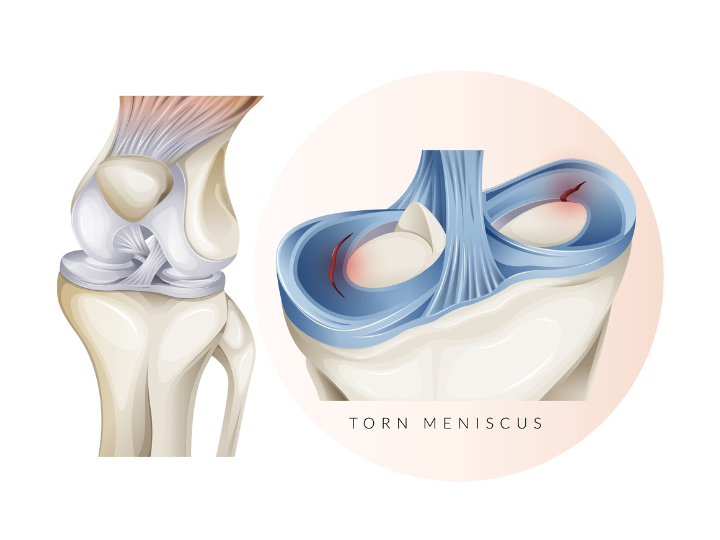
What is a meniscus?
The meniscus is a crescent-shaped fibrocartilaginous disc located at the knee, between the femur and the tibia. Each knee has two meniscus: the medial meniscus and the external meniscus. Their adhesion is with the articular surface of the tibia bone, called the tibial tubercle, inside and outside respectively. The function of the menisci is mainly, but not only, mechanical, for the absorption of loads, and better mobility of the joint.
The medial meniscus, due to its more stable connection to the tibia, is less mobile and therefore more vulnerable to injury compared to the external meniscus. In contrast, the lateral meniscus is more mobile and can better absorb the pressures on the knee.
What is a meniscus tear?
A meniscus tear is a common injury to the knee joint, especially for people who play sports. It can be traumatic or degenerative, and be caused by violent movement of the knee, wear and tear due to age or even a combination. Therefore, people who are actively active, such as athletes, but also the elderly, are at greater risk.
The severity of the rupture differs in each case, as it depends on the size of the damage and its type, such as:
- Intrameniscal rupture
- Radial tear
- Horizontal rupture
- Elongated rupture
- Bucket handle rupture
- Rupture of a parrot’s beak
- Complex rupture
In some cases, the ruptures may be accompanied by other injuries, such as the rupture of the anterior cruciate ligament.


How is a meniscus tear caused?
Acute, or traumatic, rupture is usually caused during sports activities that involve sharp turns and large knee forces, such as football, tennis, and basketball. It can also arise after activities such as deep sitting. At older ages, the rupture can occur gradually and without major injury. In particular, degenerative ruptures are common in people over 50 years of age, where the normal wear and tear of the meniscus makes them more prone to injury. Thus, even with a little exertion there is a risk of causing a meniscus rupture.
Symptoms of meniscus tear
Symptoms vary depending on the type of rupture that has been caused. However, a common symptom is knee pain, especially when movements such as turning or bending are performed. Other common symptoms include:
- Swelling of the joint (hydroarthrosis)
- Feeling stuck or instable
- Inability to fully extend or flex the knee
In severe cases, there may be difficulty supporting the body weight and a feeling that the knee is receding.
Diagnosis of meniscus tear
Initially, the patient undergoes a clinical examination, which is the most important stage of the diagnosis, where the Orthopedist performs special tests, such as the McMurray test. For a more accurate assessment and confirmation of the diagnosis, imaging methods such as X-ray and magnetic resonance imaging (MRI) are used, through which the existence of the rupture is confirmed, its extent is determined and any coexisting conditions are identified.
In some cases, the Orthopedic Surgeon may opt for arthroscopy, which offers a better picture of the condition of the tissues and articular cartilage in the knee. It is a minimally invasive procedure and can be used for both diagnosis and treatment of rupture.
Treatment of meniscus tear
The therapeutic approach depends on the type, location and size of the rupture, as well as the age and level of activity of the patient. Based on the diagnosis, the treatment to be applied can be conservative or surgical.
Conservative treatment for meniscus rupture
Conservative treatment is suitable for cases that present small or degenerative ruptures without significantly affecting the patient’s functionality. In particular, the conservative approach may include:
- Rest and avoid strain.
- Ice therapy to reduce swelling.
- Anti-inflammatory drugs for pain relief.
- Physical therapy to strengthen the muscles around the knee and restore range of motion.
Surgical treatment for meniscus rupture
Surgical treatment is necessary when the patient does not respond to conservative treatment and the rupture causes constant pain, instability or functional problems, but mainly when the rupture affects the patient’s daily life and prohibits him from his favorite activities. The operation is performed arthroscopically, i.e. with the use of two small holes in the joint and the use of a camera and special tools. Based on the size and location of the rupture, the Orthopedic Surgeon performs:
- Meniscus suturing: Special sutures are used to stabilize the rupture, allowing the meniscus to heal naturally. Rehabilitation takes several weeks and requires knee protection with load restriction.
- Partial meniscectomy: Used when suturing is not possible, such as in degenerative or radial tears. The surgeon removes the damaged part of the meniscus, maintaining as much healthy structure as possible to minimize the risk of future arthritis.
- Meniscus transplantation: It is rare and mainly concerns young patients who have undergone a complete meniscectomy. An allograft is placed, restoring functionality and reducing the risk of developing osteoarthritis.
After the operation, a personalized physiotherapy program is created, which aims to strengthen the knee muscles and restore full mobility. Recovery time depends on the type of surgery, with meniscectomy requiring around 4 weeks, while meniscus suturing may take 3 months to recover.
If you are experiencing symptoms that indicate a meniscus rupture, contact Orthopedic Surgeon Anastasios Lilikakis immediately for personalized evaluation and treatment.

 Hip Osteoarthritis

 +30 210 7292002
 alilikakis@yahoo.com